












TRI-PIVOT DOCK LEVELER
Tri-Pivot Dock Leveler
Finally — You Can Unload Safe and Fast
The Tri-Pivot™ Dock Leveler by Dockstar
Engineered for the toughest, most demanding docks, the Tri-Pivot Dock Leveler combines adaptive control, structural innovation, and advanced safety integration to help your team unload packed trailers faster, safer, and smarter than ever before.

Tri-Pivot Design

Hybrid “Flex Deck” Construction

Configurable, Retrofit-Ready Design

Intuitive Touch-Screen Interface

Safety Interlock System

Patent-Pending End Load Adaptive Control
Benefits of the Tri-Pivot™ Dock Leveler by Dockstar
⚙️ Handle Variable Trailer Heights Effortlessly
Tri-Pivot™ Design
The tri-pivot geometry allows the deck to float smoothly between uneven trailer heights, maintaining optimal contact for forklifts and pallet jacks. Unload your heaviest or most awkwardly packed trailers with confidence and speed — no more jolts, misalignment, or safety risks.
The DockStar Industrial Tri-Pivot Leveler revolutionizes loading dock operations with its industry-first three-pivot point design. This groundbreaking innovation allows for precise adjustment of the leveler’s length, ensuring a perfect fit for any sized leveler pit. Unlike traditional designs, this adaptability means hazardous gaps and uneven transitions between the dock and trailer are virtually eliminated, significantly reducing the risk of accidents and product damage.
For safety managers, this unparalleled adjustability offers peace of mind. A consistently level and stable loading platform minimizes “dock shock,” protecting both material handling equipment and personnel from jarring impacts and potential fall hazards. This precision also accommodates diverse trailer bed heights and configurations, including below-dock loading, fostering a safer, more efficient, and ultimately more productive loading and unloading environment.

🧱 End Weld Fatigue and Extend Service Life
Hybrid “Flex Deck” Construction
DockStar’s Flex Deck uses a hybrid aluminum–steel extrusion system that flexes naturally under impact instead of relying on dozens of rigid welds. By eliminating up to 80% of traditional weld points, the design disperses impact stress across the platform — not into a single failure zone.
This flexibility means fewer cracks, smoother forklift operation, and dramatically less downtime. The aluminum extrusions reinforce deck strength while maintaining a lighter overall structure, preventing fatigue that plagues conventional welded levelers.
The result is a dock leveler built to thrive under high-cycle traffic, extending lifespan and cutting maintenance costs for busy distribution and manufacturing environments.
🔧 Easy Installation, Minimal Downtime.
Configurable, Retrofit-Ready Design
Every DockStar Tri-Pivot Dock Leveler is engineered for flexibility. The configurable frame system allows the leveler to adapt to your existing dock pit — even when dimensions vary from standard sizes. This eliminates costly concrete work or major structural changes during replacement or upgrade projects.
Precision-fit mounting brackets and modular frame options make installation faster and cleaner than traditional pit systems. Whether upgrading an older mechanical leveler or standardizing across multiple dock types, the retrofit-ready design ensures a custom fit that minimizes downtime and disruption to operations.
Key Advantages:
- Custom-fit configuration: Built to match your exact pit dimensions and lip length.
- Easy integration: Works seamlessly with DockStar’s control systems and safety interlocks.
- Reduced downtime: Faster installation without the need for pit demolition or rebuilding.
- Future-proof: Allows ongoing upgrades or replacements without changing dock structure.

🖥️ Simplify Training for New Employees
This control platform is designed for all DockStar dock levelers — TriPivot, hydraulic, manual, and edge-of-dock — and integrates seamlessly with the DockStar Dual Barrier Vehicle Restraint and DockStar dock lights for a complete, intelligent dock safety system.
Intuitive Touch-Screen Control System
Designed for first-time users, the graphical interface walks operators step-by-step through setup and operation. High turnover? No problem — your team can safely use the leveler with minimal instruction.Every DockStar dock leveler — including the TriPivot — can be equipped with our intuitive touch screen dock control system. Engineered for simplicity, this system guides operators step by step, ensuring safety and efficiency at every stage of the loading process.
🧩 Seamless Control of your Entire Dock Area
Safety Interlock System
The DockStar Safety Interlock System unifies your dock equipment so everything works together automatically — levelers, vehicle restraints, dock doors, lights, and fans all operate in a single, safe sequence.
The system verifies that the vehicle restraint is engaged before the door or leveler can be activated, preventing unsafe operation and protecting workers, cargo, and equipment. Visual indicators and built-in logic guide each step, removing guesswork and improving efficiency.
By combining multiple devices under one control panel, DockStar makes dock operation simpler, safer, and fully compliant with modern safety standards.
Key Advantages:
- Unified control: Run all dock equipment from one interface.
- Smart sequencing: Prevents unsafe operation or premature entry.
- Visual confirmation: Lights and indicators for quick status checks.
- Safety first: Reduces risk of injury, damage, and compliance issues.
⚡ Solve Complex End-Load Challenges Automatically
Patent-Pending End Load Adaptive Control
Modern trailers are often packed tightly all the way to the rear doors to maximize space, but this creates a problem at the dock — most levelers extend into the doorway, blocking forklifts from reaching product stacked flush at the back.
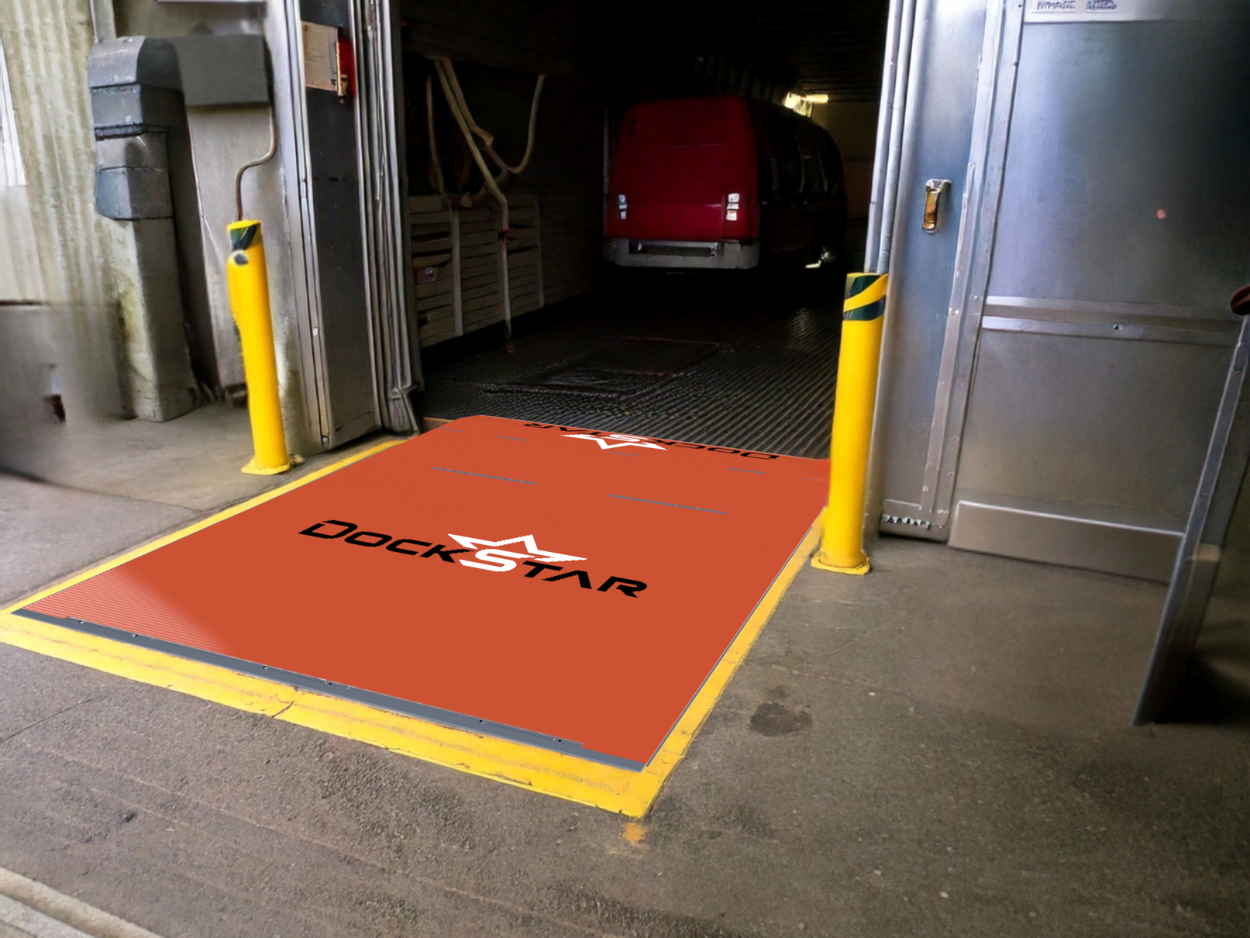
The DockStar TriPivot Dock Leveler is designed to eliminate this challenge. In end-loading mode, the deck lifts completely clear of the trailer opening and the lip tucks back into the leveler. This allows the forklift to drive right up to the edge of the dock, where the trailer floor and dock face meet, giving operators direct access to the last pallets at the rear of the truck.
The DockStar TriPivot Dock Leveler is designed to eliminate this challenge. In end-loading mode, the deck lifts completely clear of the trailer opening and the lip tucks back into the leveler. This allows the forklift to drive right up to the edge of the dock, where the trailer floor and dock face meet, giving operators direct access to the last pallets at the rear of the truck.
Why End Loading Matters
- Maximizes trailer capacity: Freight can be stacked tight to the doors without worrying about unloading issues.
- Faster turnaround: Forklifts can move directly into position without extra handling or re-stacking.
- Reduces damage: No awkward maneuvers that risk hitting product, trailer doors, or dock hardware.
- Improves safety: Operators drive straight in with stability — no risky angles or overreaching.
With its innovative tuck-in lip design, the Tri-Pivot makes true end loading possible, ensuring that every load is accessible, safe, and efficient to move.
Applications for the Tri-Pivot™ Dock Leveler

The DockStar Tri-Pivot™ Dock Leveler is built for the toughest and most demanding dock environments, where safety, reliability, and smooth operation are non-negotiable. Its unique design and features make it the ideal solution for:
- Heavy Material Handling — Perfect for facilities moving extremely heavy loads such as steel, automotive components, machinery, or bulk raw materials that demand maximum deck strength and stability.
- Delicate or High-Value Cargo — The smooth FlexDeck™ transitions and Lay Flat Lip minimize jolts and vibrations, protecting sensitive goods like electronics, glass, pharmaceuticals, or food products from damage.
- High-Throughput Docks — In operations where trailers are loaded and unloaded continuously throughout the day, the TriPivot’s durability and reduced maintenance needs keep workflows moving without costly downtime.
- Mixed Fleet Operations — Handles varying trailer heights and configurations with ease, making it versatile for warehouses serving different carriers and vehicle types.
- Cold Storage & Food Distribution — Ensures smooth, sealed transitions that help maintain temperature control and prevent product loss.
- Safety-Critical Environments — Its end-loading capability, intuitive touch screen control system, and integrated safety lights reduce operator risk and create a safer dock for both people and equipment.

Product Features
Size & Capacity
Lip Configuration
Lifting Mechanism
Long the weakness of all steel bridges, broken welds can lead to catastrophic failure of a dock leveler in a matter of months if not properly monitored and repaired. The DockStar design utilizes a platform that is 80% comprised of high strength, corrosion resistant aluminum.

FlexDeck™ Technology
DockStar’s aluminum FlexDeck™ flexes slightly for smoother dock-to-trailer transitions, reducing jolts to cargo and forklifts. With fewer welds for greater durability and a customizable pivot point to adapt to different load sizes, FlexDeck™ delivers strength, comfort, and long-term reliability in every cycle.
Lay-Flat Lip
Lay-flat lip is the first of its kind in the industry providing unsurpassed lip to deck match, crown control, a smooth transition from the leveler to the trailer and vice versa while storing in the “up” position to help prevent damage to overhead doors and protect the open drop off at the dock.
TriPivot™ Pivot Point
DockStar’s TriPivot™ pivot point delivers a customizable amount of flat deck space, creating smoother transitions for forklifts. This reduces the risk of operator injury and prevents cargo from shifting or toppling during loading and unloading.
DockStar’s Range of Loading Dock Levelers
Dockstar Industrial’s dock levelers are engineered to meet the unique demands of any loading environment, offering a comprehensive lineup of solutions to optimize safety and efficiency. From our robust mechanical dock levelers, ideal for low-volume or non-powered applications, to our high-performance hydraulic levelers that provide effortless, push-button operation for high-frequency use, we have a solution for every need. Our advanced tri-pivot levelers offer unmatched flexibility and stability, while our space-saving edge-of-dock levelers provide a simple and reliable option for lighter-duty operations. Whatever the challenge, Dockstar provides a dependable and durable dock leveler solution to keep your business moving.


Explore More Products


Frequently Asked Questions
1. What is a dock leveler and why do I need one?
A dock leveler is a device installed at the loading dock that bridges the height difference between the dock floor and the trailer bed. It allows forklifts, pallet jacks, and other equipment to roll smoothly and safely between your facility and a truck. A proper leveler improves safety, reduces equipment damage, and speeds loading/unloading.
2. What types of dock levelers are available?
The common types include:
Pit / in-floor (pit) levelers — recessed into a pit at the dock face
Edge-of-dock levelers — mounted to the face of the dock surface, no pit required
Activation modes: mechanical (spring / chain), hydraulic, or air-powered / pneumatic
Some models include lip extensions / floating lips and safety features (fall protection, cross-traffic legs)
Choosing among them depends on your site conditions, dock height variance, traffic volume, and budget.
3. How do I choose the right dock leveler for my facility?
When selecting a dock leveler, keep these factors in mind:
Dock height & trailer bed variance — ensure the leveler’s vertical range covers your highest/lowest trailer beds
Load + forklift capacity — choose a leveler rated to handle your heaviest loads plus the forklift
Cycle rate / usage frequency — for high-use docks, favor more robust or powered designs
Pit availability — if you don’t have a dock pit, edge-of-dock models might be safer and less costly
Operating method preferences — some prefer push-button hydraulic over manual mechanical
Available headroom / approach slope / dock approach geometry
Maintenance access & serviceability
4. What is a safe load rating / capacity specification?
Dock leveler capacity is usually expressed in static, rollover, and dynamic ratings:
Static load = the weight the leveler supports while stationary
Rollover load = the load it supports while a vehicle crosses over it in stored position
Dynamic load = forces when the lip meets or transitions to the trailer bed under motion
Among those, dynamic load is often the most critical in real-world usage because it reflects shifting loads and impacts.
5. How long does installation take?
A properly prepared dock site with a good contractor can often install a dock leveler in one day (excluding site prep).
However, if you need to excavate a pit, level the area, run electrical, or modify the dock approach, that prep work can add several days or more.
6. What maintenance does a dock leveler require?
To keep your leveler safe and reliable:
Conduct inspections quarterly (or more frequently in heavy use)
Check springs, chains, pivot pins, hinge mechanisms, lip operation, frame condition
Lubricate moving parts per manufacturer recommendations
Repair or replace worn parts immediately — small damage often leads to bigger issues if ignored
For hydraulic units: monitor fluid levels and seals
Proper maintenance can dramatically extend the service life of the unit.
At DockStar, we don’t just build hydraulic dock levelers; we engineer solutions that prioritize safety and performance above all else. Our dock levelers are meticulously crafted using the highest quality materials and cutting-edge manufacturing processes, ensuring unparalleled durability and reliability for even the most demanding loading dock environments. With DockStar, you’re investing in a product that not only enhances efficiency but also protects your personnel and equipment.
The DockStar Tri-Pivot dock leveler™ delivers unmatched performance and longevity with significantly fewer welds than traditional steel models, eliminating a key failure point. Its 80% aluminum platform, reinforced with extruded aluminum cross members, provides superior strength and flexibility. A unique secondary pivot creates a loading platform up to 48″ for smooth transitions, while the industry-first lay-flat lip ensures a seamless trailer interface and protects material handling equipment, personnel, products, etc. Additional features include a non-slip tread pattern, touchscreen controls (with future Control Room compatibility), an integrated safe operation sequence, and a standard light communication system.