













Custom Food-Grade Change-Part Carts
Stage 1: The Lead
Turning a Concept Into a Custom-Built Solution
DockStar Industrial recently connected with a well-known food manufacturer based in Chicago, Illinois. Their project Manager reached out through DockStar’s website with a detailed inquiry for a set of custom carts designed to safely transport change-part plates used on new packaging machines.
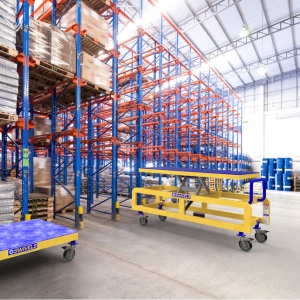
The request called for four lightweight, food-grade aluminum carts, each featuring UHMW plastic U-channel guides to support and stabilize multiple plates during movement around the plant. The customer’s note included specific dimensions, load requirements, and handling preferences — even mentioning a slotted upper guide to prevent the plates from tipping.
DockStar sales representative Scott followed up immediately with a call to discuss the details and confirm DockStar could build exactly what the customer had in mind.

Stage 2: On-Site Evaluation & Concept Sketching
Recognizing the importance of precision in a food manufacturing environment, Scott scheduled an on-site visit to the customer’s Chicago facility. Seeing the workspace in person allowed him to understand how the carts would be used — from maneuvering through production lines to fitting under existing storage and equipment layouts.
After the visit, Scott created a rough concept sketch to confirm all dimensions, safety factors, and material specifications before moving forward. This quick design step ensured DockStar and the customer were perfectly aligned on form, function, and finish.


Stage 3: Engineering & Fabrication
Once the preliminary concept was approved, Scott passed all notes and the confirmed sketch to DockStar’s engineering team. The engineers converted it into a fully rendered 3D model, allowing the customer to review and sign off on the design before fabrication began.
Each cart was designed for food-grade compliance, featuring:
- Lightweight aluminum frame construction
- Ground-down welds for a smooth, sanitary finish
- UHMW plastic channel guides for non-marring, easy-slide support
- Rubber casters — two fixed and two swivel — for stable mobility
- Powder-coated finish for durability and corrosion resistance

Stage 4: Refining the Design for Long-Term Value
Before production began, the customer reached out with a design adjustment request — to remove the toe bar from the original concept. Rather than rushing the order through, Scott and the DockStar team revised the drawing and updated the quote to reflect the change.
It’s a perfect example of DockStar’s philosophy: we’re not just trying to get a purchase order — we’re focused on building the right solution for the long haul. Every modification, material choice, and design tweak is reviewed to ensure that the final product delivers maximum performance, low maintenance, and long-term reliability in the customer’s environment.
Stage 5: Delivery & Ongoing Support
With the revised design approved, fabrication began. The finished carts were powder-coated, inspected for quality, and shipped directly to the customer’s facility in Chicago.


Scott will follow up with a site visit to ensure the carts are performing exactly as intended and to see if there are any additional opportunities to improve efficiency or safety within the plant. DockStar’s relationship doesn’t end at delivery — we stay connected to make sure every product continues to perform for years to come.
Why It Matters
This project highlights how DockStar combines responsiveness, craftsmanship, and customer partnership to deliver tailored solutions that go beyond the initial quote.
From concept sketches to engineering revisions, DockStar takes the time to get it right — ensuring every piece of custom equipment is built to last, perform safely, and minimize downtime. That’s the DockStar difference: engineered solutions, built with care, and supported for the long run.

Frequently Asked Questions:
1. Does DockStar build food-grade carts and equipment?
Yes. DockStar regularly designs and fabricates custom aluminum and stainless steel carts, tables, and material handling systems for food manufacturing environments. We use food-safe materials, smooth welds, and powder-coated finishes suitable for hygienic use.
2. Can DockStar help design a custom cart from scratch?
Absolutely. In this case, the customer had a clear concept, but we often start from a simple idea or description. DockStar’s sales and engineering teams can sketch, design, and engineer a completely new cart or fixture based on your workflow and space.
3. What materials can DockStar use for custom carts?
We work with aluminum, stainless steel, UHMW plastic, and mild steel depending on the application. For food processing or packaging environments, we typically recommend aluminum or stainless for corrosion resistance and cleanliness.
4. How many units can DockStar produce?
DockStar can fabricate anywhere from a single prototype to large production runs, depending on project needs. In this project, we built four custom units, but we also handle multi-facility rollouts for larger operations.
5. How long does a custom cart project take?
Typical timelines range from 4 to 8 weeks from concept approval to delivery, depending on complexity and materials. DockStar provides clear lead times during the quoting process to help customers plan production schedules.
6. Does DockStar handle installation or delivery?
Yes — we can ship directly to your facility or coordinate installation and setup if required. For this project, the finished carts were shipped directly to the customer’s Chicago plant.
7. How much does a custom food-grade cart cost?
Pricing for custom food-grade carts depends on the size, materials, and level of customization required, but most projects fall within a predictable range.
For example, a single lightweight aluminum cart designed for food manufacturing use generally starts around $2,500–$4,000 per unit, depending on dimensions, weld finish, and mobility requirements. Projects involving multiple carts or specialized design features — such as UHMW plastic channels, custom powder coating, or heavy-duty load capacities — typically range between $10,000 and $25,000 for a small production run.