













Spill Containment 101 – Your 2025 Guide
Spill Containment 101
In fast-paced industrial environments, a single spill can halt operations, invite regulatory penalties, or create serious safety hazards. Spill Containment 101 lays out smart, effective strategies for containing hazardous liquids—whether around storage drums, dock bays, or transfer zones. This guide equips facility, safety, and procurement managers with the practical tools they need to protect uptime, support compliance, and deliver ROI without endless vendor hassle.
Spill Containment 101 isn’t just safety theory—it’s about real-world, actionable solutions like portable berms, pallet systems, and dock-integrated containment that target common risks. Whether you manage chemical storage near dock levelers or oversee high-volume loading operations, this post addresses the questions you face: What counts as compliant containment? Which cost-efficient systems work best? How do you avoid downtime while meeting OSHA standards?
What Is Spill Containment?
Spill Containment 101 begins by defining spill containment as the systems and practices that keep hazardous liquids from spreading—in storage areas, dock bays, or transfer zones. It focuses on physical barriers, retention equipment, and strategic layout that together protect surfaces, personnel, and regulatory compliance.
Solutions range from mobile containment pallets under drums to berms that isolate trailers at the loading dock. Equipment like spill walls, absorbents, and drainage covers channel or trap leaks before they compromise operations. Tailoring containment to your facility’s workflow ensures hazards are localized and disruptions stay minimal.
Good containment minimizes slip risks, environmental exposure, and cleanup time. It’s essential for safeguarding both team members and productivity—especially when docks revolve around busy loading-dock safety and logistics flows.
Regulations & Compliance
Any discussion of Spill Containment 101 must address compliance—with OSHA 29 CFR 1910.120 for hazardous materials handling and EPA SPCC standards for secondary containment. OSHA requires emergency planning and spill kits in handling areas, while the EPA specifies that containment must hold at least 10 % of total storage or 100 % of the largest single container.
Maintaining compliance means keeping written procedures, training staff on response protocols, and ensuring that containment infrastructure meets ANSI quality standards. Use durable solutions that stand up to daily wear—while helping keep your facility inspection-ready and operationally resilient.
External guidance and best practices can be found at sites like the EPA’s SPCC Overview (from epa.gov)—a reliable resource for containment thresholds and design expectations.
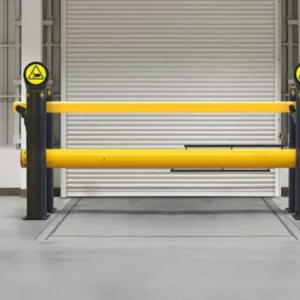
Protective railings also play a role in compliance by physically separating containment areas from pedestrian zones, reducing risk of accidental exposure.
Containment Equipment & Options
In Spill Containment 101, equipment selection is key. Options include drum spill pallets, absorbent socks, modular berms, spill decks, and drain covers. Each serves a specific role depending on container size, hazard type, and surface layout.
Drum Containment & Berms

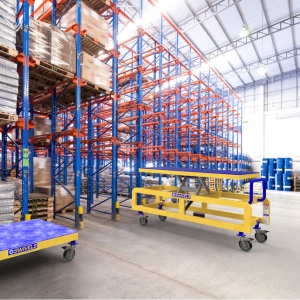
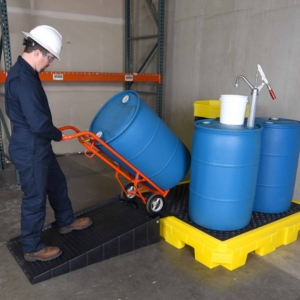
The image above showcases a drum-spill pallet used under storage drums and a modular containment berm designed for vehicle or equipment placement. These systems play a central role in preventing liquid transfer to sensitive zones.
Truck Containment Wall

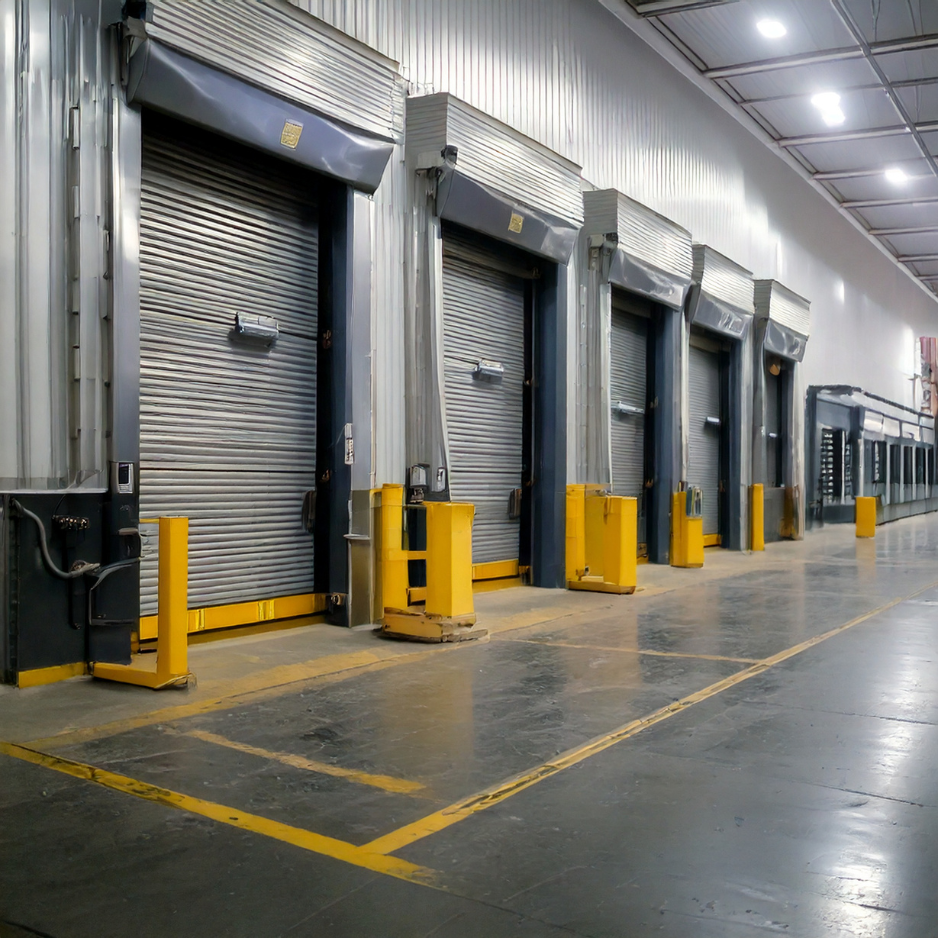
Here, a truck containment wall secures loading-dock perimeters when tankers or cargo vehicles operate. It protects against leaks that could otherwise cascade into congested bays and compromise dock-level safety.
Pair these with dock levelers and vehicle restraints to control traffic and structural loading—while ensuring any accidental spills remain contained.
| Containment Option | Best Use Case | Primary Benefit |
|---|---|---|
| Spill Pallets | Drums, small containers | Simple, cost-effective secondary containment |
| Modular Berms | Dock bays, equipment staging | Scalable, portable, quick to deploy |
| Absorbent Kits | Minor leaks | Rapid response, minimizes downtime |
| Spill Decks | Medium-sized chemical setups | Easily integrates with shelving systems |
| Containment Walls | Dock-level vehicle staging | Protects bays from bulk spills |
Benefits of Spill Containment Systems
Spill Containment 101 addresses why containment matters—from operational continuity to legal safety and asset protection. Systems designed for your facility help avoid slip injuries, avoid regulatory fines, and strengthen uptime.
Containment reduces clean-up duration, particularly after high-volume transfers or volatile material handling. That means less downtime, lower labor costs, and faster turnaround at high-use dock doors. It’s also a preventive maintenance tool: pooled chemicals deteriorate flooring, seals, and dock leveler components; containment preserves that infrastructure.
Beyond the physical and financial benefits, containment systems enhance worker safety. Reduced exposure to hazardous liquids cuts injury rates and compensation claims. A safer environment bolsters team morale—which, in turn, supports retention and operational consistency at mid- to large-scale facilities.
Best Practices for Implementation
Spill Containment 101 concludes with deployment strategies. Effective systems result from upfront layout planning, risk mapping, regular training, and scheduled maintenance. Aligning containment with traffic controls, dock levelers, and vehicle restraints avoids blind spots.
Best practices include stocking spill kits near dock entrances, installing berms where trucks and trailers regularly load, and conducting quarterly inspections. Staff training on leak detection and response, along with clear signage, ensures quick containment in emergency scenarios.
Tracking KPIs—like spill count, cleanup time, and containment response cost—helps measure ROI and make data-driven upgrades. For insight into safety reporting metrics, check out DockStar’s Accident Frequency Rate glossary resource.
Frequently Asked Questions
- Q: Which liquids need containment?
A: Any oils, fuels, solvents, or hazardous substances regulated by OSHA or EPA SPCC rules. - Q: How often should containment gear be inspected?
A: Minimum quarterly—and more often in high-traffic or high-risk zones like dock bays. - Q: Do spill pallets satisfy compliance standards?
A: Yes—as long as they meet required secondary containment volume (10 % of total or 100 % of largest unit). - Q: Can containment be tailored to dock architecture?
A: Yes; modular berms and walls can be configured to fit dock widths, trailer types, and facility layout. - Q: Where can I find official OSHA guidance?
A: Visit OSHA’s hazardous-materials guidance at osha.gov/hazardous-materials.
Key Takeaways
- Spill Containment 101 equips facility leaders to contain hazardous liquids with precision.
- Systems must meet OSHA and EPA SPCC secondary containment thresholds.
- Choose solutions that match drums, dock workflows, or vehicle staging—as shown in this post.
- Effective containment protects uptime, reduces costs, and strengthens ROI.
- Training, inspections, and metrics drive long-lasting safety improvements.


[…] Achieving compliance requires a strategic approach. Start by understanding the regulations that apply to your facility. Safety Cabinet Warehouse offers solutions that meet stringent standards, ensuring you’re always compliant. Regular inspections and upgrades to your storage solutions keep you ahead of any regulatory changes. Remember, most people overlook the importance of routine checks, but these can save you from future headaches. For more insights on spill containment, check out this comprehensive guide. […]